
Optical prescription software
Refraction software for eye doctors—structured, fast, defensible
If your “EMR” still dumps refraction into a single free-text box, you are losing time at the chair and risking inconsistent optical handoffs. EyeHMS treats refraction as a first-class workflow: visit-linked, field-validated, and ready for counselling and optical teams to trust.
Why structured refraction matters in Indian OPD
High volume + optical revenue + medico-legal expectations = you need optical prescription software that matches how you actually prescribe—not how a generic hospital IT vendor imagines it.
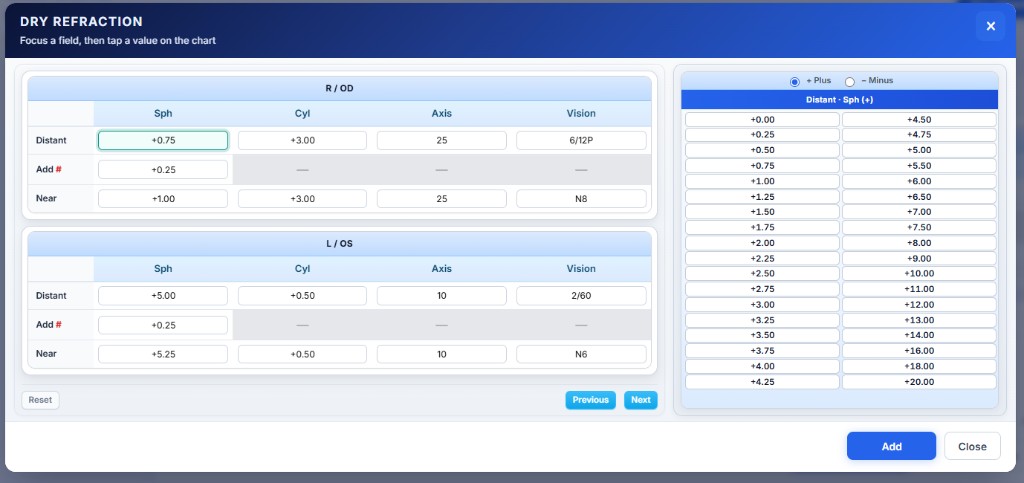
What “good” refraction software does for your clinic
Refraction software for eye doctors should do more than digitise a paper form. It should reduce cognitive load during the consult, minimise transcription errors from autorefractor or retinoscopy into the final prescription, and preserve a timeline when the same patient returns with complaints about progressive lenses or post-cataract dysphotopsia. That is the bar EyeHMS is built around.
In a typical Indian phaco or refractive practice, the refraction step sits between triage and counselling. If data is messy, counselling over-promises, optical quotes the wrong add, and the doctor ends up redoing work. Clean fields for distance sphere, cylinder, axis for each eye—and coherent handling of add and near—keep the chain honest from chair to billing.
Distance, add, and near: one optical story
Patients rarely understand “add” in plain language, but your software must. Optical prescription software should reflect how ophthalmologists think: distance correction first, then near requirements, then how those combine for progressive or office lenses. When add powers change the derived near row, the system should stay internally consistent so technicians are not left guessing whether the near cylinder follows the distance axis.
Fewer “fat finger” moments
Small dioptre mistakes have large consequences—wrong axis, swapped eyes, or missing cylinder on high astigmats. Field-level discipline and validation patterns (the kind EyeHMS applies in its refraction module) catch a meaningful share of issues before they reach print or WhatsApp forwards.
Visit-linked history—not a loose folder
Refraction is not a standalone event; it belongs to a visit on a date with a doctor context. When refraction software for eye doctors stores each record against the correct visit, medico-legal review becomes simpler and progression discussions become honest. You can answer: “What did we prescribe three months ago before the cataract surgery?” without trawling paper.
Handoff to optical and counselling
Counselling teams often need the same numbers the doctor finalised—plus any remarks on tolerance or monovision strategy. When optical prescription software keeps remarks alongside structured fields, you reduce verbal relay errors between rooms.
Print-ready output patients respect
Many patients still walk out expecting a physical Rx. A professional PDF summary—aligned to the same structured data—signals quality and reduces disputes later. EyeHMS is designed so your digital refraction and printed output stay in sync, without retyping into Word templates at midnight.
Who benefits day one?
- Consultants spend less time fighting the UI and more time on the slit lamp.
- Fellows and associates follow a consistent pattern across rooms.
- Optical desks receive cleaner inputs for edging and lens design.
- Owners see refraction as part of a measurable OPD pipeline—not a black box.
How EyeHMS compares to paper + Excel workarounds
Many centres still use pre-printed refraction sheets and later scan them “into the system.” That approach creates double work, blurry scans, and no structured search. Optical prescription software eliminates the second pass: the doctor’s keystrokes are the system of record from the start. Reporting, audits, and analytics—all downstream—become possible without hiring a back-office team to re-key data.
Spreadsheet templates are another common hack. They version poorly across branches, offer weak permission control, and break the moment two staff edit the same row. Purpose-built refraction software for eye doctors centralises updates, enforces role boundaries, and keeps every change tied to a real patient encounter instead of a filename like Rx_FINAL_v7.xls.
Refraction + queue + documents = one product story
Refraction software works best when it is not an island. EyeHMS connects refraction with OPD queue management and patient records so the same visit flows from check-in to documentation. That is how you actually shorten waits: not by typing faster, but by removing dead handoffs.
See refraction inside the full EyeHMS flow
Live demo · tailored to your chair layout